 The Crosswalk
Accused of Using AI? How to Prove You Wrote Your Own Paper
A mom’s guide to defending your academic integrity with version history, cloud backups, and calm communication
I started to write this post last week and ended up writing about how the "AI is coming for us" talk we hear is misleading. I've been fiddling with this post for like a whole week and struggling in general with a lot of AI that's been inserted into my daily life. I don't want to start writing about AI all the time, but it's just suddently been thrust upon my day to day in such a way that I've been using movies, games, reading, and writing to work through some stuff.
The "AI is coming for you" shifts the focus away from the human role in how AI, particularly LLMs, is used and developed. "But the AI said," has been something I'm hearing much more often recently.
This post is about how to establish evidence of your authorship in this age of AI. Admittedly, I don't have evidence of the countless changes and drafts I've made for this blog, and I'm not sure anyone wants to see it. But I assure you, I'm here.
Big tech or no?
I'll talk about options that involve big tech and some that don't. If I were in high school or undergrad and I wasn't technical and didn't plan to be, I might use Google docs and its version history for my school papers.
At the graduate level for work intended to go to a scholarly journal, you could also do that, but I would use a private git repo for version control.
Set up vs response
The first half of this blog post is about how to set up your insurance policy in case you are accused of academic dishonesty. You have to have evidence that you wrote your paper, for example.
The second half is what I would do if I were accused. This is partly based on my own run ins with bureaucracy, false accusaions, getting pulled into workplace incidents as a witness, and employment disputes.
The age of LLMs as they are today is way way after my school time. I did a lot of reading and research to support what I say here, but even if my suggestions are great, make sure you ask your college/university writing center for their recommendations. Ask your guidance counselor, a trusted professor, or trusted teacher. Refer to your university policies. Find some info specific to your school from your school if you can.
Your school's policy
I tried to find university academic honesty policies and I couldn't find any policies that call out AI or LLM a model that generates text in a different way than next-word prediction had worked in the past - think ChatGPT and Claude use in your academic work, except this one, but it's vague and just says it includes AI use as of this writing. I saw a lot of "don't use another student's paper as your own," but that's not what we're talking about here.
Refer to your school's policies, check your prof's syllabus, and ask your teachers. If I was in school, I'd go to the writing center and ask about this topic. It's not enough to NOT use AI. The burden is on the student to keep evidence that their writing is their own. There seems to be no firm guidance for what students should do.
There are court cases and papers you can cite that demonstrate that AI Detector software is not reliable or robust. Gather that if you're accused.
School's appeal process
If you get caught up in a bureaucratic process, review what is happening and ask for policy or procedure in writing. Ask if you get some kind of support for the process. Note anything odd that occurs like, does an accuser or the judge/determiner review an appeal? If something doesn't sound right, speak up. That particular thing was one part of the Matter of Newby v. Adelphi University
Writing process
I would make sure to create artifacts of the writing process if I were in school.
- Notes
- Browser Lets you visit pages on the internet, examples are Safari, Edge, Firefox, or Brave. history
- Research notes
- Outline
- Thesis statement
- Multiple drafts (outline, thesis, paragraph topic with supporting evidence, fill in the paragraphs, add transitions, etc)
- Drafts with comments from friends, tutors, or mentors
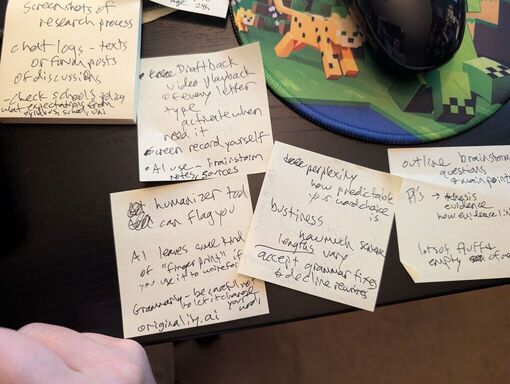
Here's an example of some of my sticky notes. I have a spiral notebook that I write in, too, sometimes.
Drafts
These can be saved separately, e-mailed to yourself for a timestamp a date and time stamped on a log entry or file, so you know exactly when something happened , or done completely in Google docs so each file has a version history. The git option also saves version history.
Handwritten notes
I like to hand write notes a lot of times, and I would probably take photos of these to save with the rest of my notes and drafts.
Research notes
When I say research notes above, I mean notes about your sources and where you looked for info. What I would do is annotate any PDFs I download to read and use for a paper. You can draw on them, highlight, comment, etc, on the file. If you're accused of making up references that don't exist, you'll want to have references on hand to share.
References
There are many tools nowadays for organizing and using references in your documents. Word and LibreOffice Writer have functionality so you can create references in the application that are used. There are extensions to help with things like this and to integrate with things like Google Scholar.
If it were me, I'd use something that can save all my references and notes on them in one place. When I was in grad school, there was a program called Endnote that I used.
Git
If I was in school at a grad school level today, I wouldn't feel comfortable using big tech platforms for my papers. I would likely use private git repos to keep versions of any writing. I can write about this if anyone's interested. It's a way to create an immutable, signed trail of your work. You have to set it up a certain way so that your commits (each version) are signed.
File organization - or at least file name keywords
File organization can help you more than you would think for this endeavor. You need to be able to find your essay to turn it in and to work on it. You need to be able to find your evidence if you're accused of cheating. If you're not organized, don't worry. I have a suggestion for you too.
The important thing is to do something that you'll actually do. Don't take something that I, or anyone else, suggests if you're not actually going to stick with it.
If it gives you the ick, it won't stick.
The goal is to be able to find everything related to your paper if you need it. Do what works for you to make it happen. I have two suggestions below.
-
Each essay paper should have its own location where you keep notes and the paper together. Staying organized can help you find evidence later. You don't have to go overboard, just make sure you keep all files and notes together if possible.
-
If you're using different tools that save things in different places, keep folder names the same across them or maybe save exported copies to your one single folder from option 1.
-
Another option if you're NOT organized, at least make sure everything related to each essay has a keyword in the file names that are unique so if you need to search, it'll come up.
- In this case, it might be helpful to have a master file that tells you what keyword you used for each paper. Include dates and what class it was for.
Possibly record your screen
Browser Lets you visit pages on the internet, examples are Safari, Edge, Firefox, or Brave. extension for recording or literally record
If you literally record your screen or use a browser Lets you visit pages on the internet, examples are Safari, Edge, Firefox, or Brave. extension that records your typing, then you have a record that can show every letter and copy paste as it appears on the screen.
Be cautious what you download for a recording browser Lets you visit pages on the internet, examples are Safari, Edge, Firefox, or Brave. extension because keystroke loggers are also a tool for stealing information like passwords, credit cards, usernames, and bank account numbers.
Here's an example of a recording. I sped it up and put into a video to make it small and not annoying for website purposes. If I was keeping it for real as proof of authorship, I would keep it as is and make sure all my stuff was backed up.
If it was for school, I'd probably back it up in Google Drive. The original recording I'm showing below was about 8 minutes using the GNOME screen recorder and was almost 19MB. Video can be compressed further so it doesn't take as much space and it'll look the same, but I only know
terminal
a text-based tool where you navigate your system and run commands by typing instead of clicking in a user interface
commands for that type of thing. If you're comfortable with the
terminal
a text-based tool where you navigate your system and run commands by typing instead of clicking in a user interface
and bash, ffmpeg is a tool for
Linux
An alternative to Windows or MacOS on computers.
that can make your videos take up less space.
Backups
I would recommend that whatever you do, keep copies of files and evidence backed up somewhere that you control. Here's my post about options for backing up files. In some instances, I would print copies of things, like if someone told me the matter was closed and no further investigation would be occurring.
Communications about the writing
If you have any emails, texts, or other communications with friends, mentors, or a writing center about drafts and the writing process, include those in your evidence folder. Or make sure you tag them in your e-mail inbox or are able to retrieve them in a search somehow later.
I noticed in some academic integrity policies that some universities say not to e-mail or share papers with friends or classmates, because you could be implicated if that person uses your paper as their own work. Use your judgement. Or use your university's writing center!
AI attribution
Depending on your school's policy, doing some brainstorming and asking for references might be ok with AI. Be honest about your usage when you do this and include an attribution at the end of your paper. Review your school's policy or ask the appropriate people what the guidance is on this. In some schools, it's zero tolerance. So in those cases, be cautious when using grammar-checkers as well. Grammarly seems to get called out as the boogeyman in a lot of these stories about AI usage in school.
Research on AI detectors
If I was accused of using AI because a professor decided to run it through an AI detector, I might provide recent research about how those tools are not reliable or robust. I wouldn't come out of the gate with this. I would first ask some questions of the faculty member accusing. If you can change their mind, then the situation doesn't have to escalate.
In my recent post, I include a list of new (2026) and old (2023, ancient times) references. I would recommend using that list and submit relevant links to either the professor, the dean, or whoever is appropriate depending on the status of the accusation and where you are in the process. But wait for the appropriate time. If they say their accusation is fully or mainly based on an AI detector, respond providing information about how those are not reliable. It is commonly considered insufficient evidence by itself of AI use by a student. The university may prohibit it as evidence.
E-mail your prof or teacher
If I received a notification that says I'm accused of something, the first thing I would do is e-mail my teacher back to ask for details and an in-person meeting.
That first e-mail
If you get some automated e-mail that calls out a particular class or professor, or an e-mail directly from the professor, respond to that, make sure the prof is in the "to" and ask for details about the accusation and what evidence it's based on. i would plainly ask that exact thing:
"Could you please provide me details of the accusation and the evidence it's based on? I have plenty of evidence to show my authorship, and would be happy to meet with you to share it. I didn't use AI in this paper.
What time works best for you this week to meet? I can talk to you about the process I used to write my paper step by step as well at this meeting."
Something like that. Make sure you're truthful and factual in your communications. Don't vent in your e-mail. Don't include your feelings. Vent to a friend first if you need to.
E-mail advice
Keep each communication as brief as possible, because people can't absorb big long e-mails. It also makes it clear that you were calm and reasonable in your communication.
Give them a chance to explain or find out the process
My follow ups for difficult conversations depend on the response. The idea is to give them room to explain themselves. They owe you an explanation and evidence, and you just need to calmly ask for it while asserting the facts.
If there is no chance to explain and it's immediately escalated to some meeting with a committee, I would try to find out what the full process is. You might need to gather all your evidence and AI detection references for one big thing.
Cross reference accusation with policy
If you're still able to discuss with the teacher with a little back and forth before something else, check their response with the university policy.
After you get the exact accusation and the evidence, cross reference that with the appropriate policies. I mention that in the next section. If the evidence isn't sufficient according to the university AI policy, provide that information, and reiterate that you would be happy to meet, "What time works best for you?"
You might have to escalate things yourself
There are some people who will go back and forth endlessly or provide you with information and policy that is outdated or not quite right. Be mindful and watchful about that sort of thing. Make sure you get things in writing and find references to updated policy and procedure.
In addition, you might have to stop responding to e-mail back and forth with a professor. Depending on personalities, there is a time when you may need to stop responding and contact the next person in the chain to talk to.
High school
If this was not me in college but my child in high school, I would reach out to the teacher and ask for a meeting. If they didn't provide clear information about the accusation or evidence. I would ask again on my child's behalf. I would reach out to the principal also. I would make this into a thing because it's a serious matter to be accused of cheating. It can cost money and affect your prospects.

Be nice = be assertive
The "not be nice" part would be escalating the situation up the chain and being assertive. This is not the time to say, "I don't want to be a bother." The accuser is the one being a bother if this is a baseless accusation.
If you're a woman, being assertive is often seen as "not nice." So that's the time for you "to not be nice."
Should you run your work through an AI detector?
I saw advice saying you should do this and some advice saying you shouldn't.
If it was me, I would either be cautious or use a tool that your instructors or school don't use. The reason I suggest that you exercise caution is because if you submit your work to an AI detector, it may then register your work in its training data and then flag it as similar when your teacher or instructor run it through their tool. On the one hand, you could benefit from having different scores from a couple of tools (there are many out there) to show how unreliable these tools are. On the other hand, it may cause you more trouble than it's worth.
Here are examples of ones you can use:
There are many out there.
- https://originality.ai
- https://copyleaks.com/ai-detector
- https://gptzero.me/students
- https://quillbot.com/ai-content-detector
- https://www.turnitin.com/products/feedback-studio/
When I first looked at Turnitin's website, I was surprised. I remember when it was new and used as a plagiarism checker, even though they say it's not able to detect plagiarism. The thing I was surprised about was that it looks like it's a writing platform that helps you to record your writing process. They offer writing services. My initial impression is this sort of thing is turning into is own ecosystem. The AI tools charge you for features, they charge the schools, and they have no incentive to fix their false positives because that funnels you into paying for their BS.
It assigns a score of similarity to other text it knows about. The similarity scores can be applied to a student's prior work. It has some functionality to not flag something like that, but if you turn in papers logged in as a different user, it will flag it. For example, your high school papers, and then let's say you go to community college before you go to a 4-year university. Or if you log log files in a computer are notes where programs record events, messages, warnings, and errors so you can see what happened and when in as yourself with your personal e-mail to have it scan papers before you turn them in to your classes.
Conclusion
In conclusion, some simple actions can protect you and your academic record. Take a few steps now as a low effort insurance policy. A false accusation can endanger your status, scholarships, program participation, visa, or cost you money in fees. If you aren't treated fairly and can't afford a lawyer, you have to do what you can for yourself, and I hope there's something helpful in here for you.
But by automating your version history, staying organized, and communicating calmly and factually, it's possible to turn a stressful situation into an administrative hurdle that you can clear.
Image credit Markus Winkler: https://www.pexels.com/@markus-winkler-1430818/
Related Posts
Just How Different Are Our Online Experiences?
A reflection on how algorithms in streaming and social media create isolated digital worlds, reducing shared cultural experiences.
Connect to the Cloud Seamlessly on Linux
Moving to Linux doesn't mean giving up cloud backup. Learn how to connect Google Drive, OneDrive, and Dropbox seamlessly on Ubuntu and Zorin using point-and-click tools, plus the critical warning about permanent file deletion you need to know before you start.
Google Play Services Explained: What It Collects and How GrapheneOS Gives You Control
Wondering what data Google Play Services collects from your phone? Learn what information is being tracked, why it matters for your family's privacy, and how GrapheneOS lets you keep using essential apps while controlling what gets sent out.

About Katie B
I'm a mom and a programmer in the mid-Atlantic region of the USA. I like reading, games, hiking.
📬 Join the Newsletter
Get thoughtful writing and practical tips delivered to your inbox. No spam, just meaningful content. Make sure to check your e-mail (and maybe your spam/junk folder) for an e-mail to confirm your subscription!
Frequently asked questions
What should I do first if my professor accuses me of using AI?
Reply calmly and factually via email. Ask for the specific evidence and details of the accusation. Do not vent or get emotional. State clearly that you didn't use AI and are willing to meet to show your work.
Can I use LibreOffice and Google Drive to prove I wrote a paper myself?
Yes. You can record your writing, save artifacts of the writing process without the cloud version history. However, I can't guarantee that will be accepted as enough evidence. If you need that peace of mind of a cloud-backed version history, you can connecting Google Drive via GNOME Online Accounts in Linux. That way, you can save documents directly to the cloud. If you're on Windows, Google can be connected to LibreOffice in a similar way. Test the version history functionality to make sure you can see it yourself. You're the one who would have to share or retrieve it. Make sure you can download versions yourself as backup. Google Drive automatically creates version history, which serves as strong evidence of your writing process and timeline.
Are AI detectors reliable evidence of cheating?
No. Research shows AI detectors are highly unreliable and prone to false positives. If an accusation is based solely on a detector score, you can provide this research to the professor or dean to challenge the validity of the evidence.
How can I prevent false AI accusations in the future?
Maintain a cloud-controlled version history (like Google Drive). Keep all drafts, notes, and research materials organized in a dedicated folder for each assignment.