 The Crosswalk
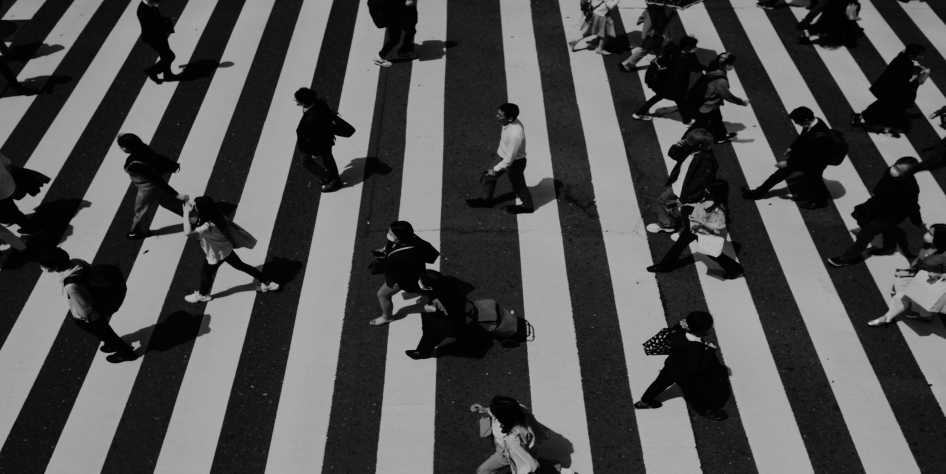
Just How Different Are Our Online Experiences?
The cost of personalized content.
Once upon a time we used to walk the in-person video stores near home and make a selection to watch. This was an experience, different in many ways from scrolling through digital rectangles displayed on a screen.
You wandered among shelves full of movie titles facing you, not terribly different from scrolling the thumbnails on the TV. You could spend a long time looking for something to watch when you didn't know what you wanted to watch, but you likely wouldn't scroll a whole hour and then realize so much time had gone by. The environment would change around you. People would come and go. You might be able to tell the sun going down in the evening. You walk by different size shelves. Maybe you'd walk by a new release shelf with 30 copies of the latest big hit ready to take home.
You'd see people gathered around a certain shelf and maybe look to see what it was. You'd overhear people talk to each other. You might go ask the employee what they would recommend. You see a friend or acquaintance and rent something you might have overlooked just because you went over to a different section to say "hi."
There's something else happening in this situation that's different now. I mean, besides the physical store part. There were a lot of choices, but not as many as now. And everyone saw the same options. People talk a lot about how we have so much choice and its effect on our brains, but I'm going to talk about how it relates to our relationships with one another.
So I always thought it was cool that the younger generation seems to be fine with people liking different things. When I was younger, it wasn't cool at all to like anime. Now it's just something else people watch. Different cultural experiences are not necessarily an occasion to clutch your pearls. Older generations might be more likely to say, incredulously, something like "You've never heard of James Cagney?" or "You've never seen Singin' in the Rain?" I've never heard someone younger than me say something like that. I've uttered it only one time in the same way when my partner and I encountered a young check out guy at the grocery who hadn't seen "Back to the Future," one of our favorite movies of all time. Oops, sorry, it just slipped out.
It wasn't weird, though, that he hadn't seen it, because there is so much to watch. Think about it this way. The distance between now and when the movie was released (41 years) is already much longer than the distance in time between 1985 and 1955 (30 years).
The other thing that struck me recently came while one of my best friends and I watched a movie. She saw it and knew I'd like it, but I had never heard of it before and my algorithms had never recommended it to me. After we experienced this emotional roller coaster of a movie, we were looking for something funny and dumb to cleanse the brain-palette. While we were scrolling titles on the TV, I noticed that every single thing on the screen was different from what's recommended to me. Every. Single. Thing. I recognized maybe one title.
I knew that we were all served different feeds in social media and streaming services, different ads here and there, but I didn't realize that they'd ALL be different. I wouldn't be surprised if maybe we'd be in different sections of the video store, but not different video stores on opposite ends of town! This felt like visiting Canada. It felt the same, but I didn't recognize brands and celebrities.
Like I said, one positive is that there's less pressure to watch certain things and less pressure to like what everyone else says you should. There's no group of "cool kids" saying I have to like the Marvel Cinematic Universe. There's less pressure to have shared cultural knowledge. But have we lost that common experience on top of in-person interactions? It's giving that polarizing feeling.
One place that is often cited as polarizing is Facebook. Now, I knew that some of my family and friends were seeing very different content than I see on there. They post stuff that I think is just out there and wild. Untethered from reality. But they think the stuff I value and believe is "brainwashing." Even though I grew up in their world, only subject to the same "brainwashing" they were.
The internet is a big place. I knew they saw different content from me. But seeing my video streaming service displays everything different, it really hit me.... All the big platforms are big. It's not "big" tech for nothing. But the amount of things people can be shown that are completely different is staggering.
There are a lot of reasons we see the types of posts we see online. Some of it was people felt pushed aside because of bad experiences with doctors, authority, and dudes in their ivory towers. I've had my share, believe me. My point in this post is that there is more than just social media algorithms contributing to these ways that people view "them." The other people. Those people who "aren't like us."
It's really becoming obvious that the more time we spend, the more attention we spend, in digital spaces, the easier it is to get invested in the "reality" you're presented. Especially if it sounds good as short text on a picturesque landscape. This can be counter to what you've learned from the other people you interact with, or used to interact with, regularly.
We used to have a slow, visceral experience anchored in space-time in the store. We walked around shelves, surrounded by other people and cues for how much time has passed. Now, our search for movies and shows is accompanied by satisfying sound effects and dopamine rewards from wondering what movies will load on the next row.
If we don't think about how the many small choices in everyday, mundane life distance us, how relying on tech too much distances us from each other, and how physically and culturally distant in every way we are from the people who make decisions for our lives, then we allow those people who control the algorithm to do our thinking for us.
People seem too quick to believe the worst in "the other side." In online spaces for both "sides" people talk about how the out group, "they," live in a different reality. That might not be too far from the truth no matter who is talking.
I think we can still like what we like while remaining mindful of what comes our way and know there's a whole world of stuff out there that might be different from yours.
The reason I focus on movies, TV shows, and music, is because art and storytelling are powerful.
Dr. Amanda Podany gave a really touching intro to the Mesopotamia Great Course.** Despite how different their lives are from ours in a lot of ways, with clay tablets (not digital ones 😱) and many gods, they weren't that different from us. They were real people. Maybe her words are something we need to start with in an age when even your neighbor is often reduced to a monster or caricature in social media:
"we have this shared humanity ... They worried about their families. Somebody left on a trip and they would write letters to one another to make sure they were OK. They would be concerned about their children. ... they ate the same, many of the same things we do today. ... they had houses, they had streets, they had cities, they had so many things that ... we still live with. ... it hasn't been radically changed, things like justice ... and farming ..., and so forth. It's become more technologically advanced, but the way we cook is the way we cook, still- those things we share a lot."
We care about our families, blood or chosen. We eat a lot of the same food. We participate in school, work, commuting, travel, play. We may watch a lot of different movies, listen to different music, but we enjoy a lot of the same things anyway. We want to go places, like the store, the library, and school, without worrying about our safety. We want to be able to be ourselves and to be free.
** I can't find the exact words from the Great Courses, but until I do, I managed to find an interview where she said something very similar
Related Posts
Accused of Using AI? How to Prove You Wrote Your Own Paper
If a professor accuses you of using AI, don't panic. This post offers easy ways to store evidence of your writing AND what I would do if I was accused of using AI in high school or college.
Connect to the Cloud Seamlessly on Linux
Moving to Linux doesn't mean giving up cloud backup. Learn how to connect Google Drive, OneDrive, and Dropbox seamlessly on Ubuntu and Zorin using point-and-click tools, plus the critical warning about permanent file deletion you need to know before you start.
Google Play Services Explained: What It Collects and How GrapheneOS Gives You Control
Wondering what data Google Play Services collects from your phone? Learn what information is being tracked, why it matters for your family's privacy, and how GrapheneOS lets you keep using essential apps while controlling what gets sent out.

About Katie B
I'm a mom and a programmer in the mid-Atlantic region of the USA. I like reading, games, hiking.
📬 Join the Newsletter
Get thoughtful writing and practical tips delivered to your inbox. No spam, just meaningful content. Make sure to check your e-mail (and maybe your spam/junk folder) for an e-mail to confirm your subscription!
Frequently asked questions
Why do different people see completely different content on streaming platforms?
Streaming services use recommendation algorithms that personalize feeds based on viewing history, clicks, likes, and more, creating a unique experience tailored for each user. Unlike video stores where everyone saw the same physical shelves, no two users necessarily see the same recommendations.
What was lost when we moved from video rental stores to streaming?
Video stores offered in-person interactions, shared cultural reference points, and a slower browsing experience anchored in physical space. Streaming provides more choice but fragments our common cultural knowledge.
How do algorithms contribute to polarization?
When people see entirely different content feeds, including social media posts, news, music, games, and other entertainment, they could develop different perceptions of reality.